
What Is Tesamorelin?
Tesamorelin is a synthetic 44-amino acid peptide that mimics the first 44 amino acids of human GHRH. It is modified with a 3-hexenoic acid group at the N-terminal end, which makes it significantly more resistant to enzymatic degradation by **DPP-4** compared to native GHRH.
In clinical and laboratory research, Tesamorelin is used to study the selective reduction of abdominal fat without the systemic side effects typically associated with direct growth hormone administration.
⚗️ Key Facts
- Molecular formula: C221H366N72O67S
- Molecular weight: 5135.9 g/mol
- Class: GHRH (Growth Hormone Releasing Hormone) Analogue
- Research purity (Nūmira): >98%
- Form: Lyophilized powder
Mechanism: The GHRH Pathway
Tesamorelin acts on the **somatotropic axis** — the hormonal system that controls growth and development:
1. Pituitary Stimulation
It binds to GHRH receptors on the somatotroph cells of the anterior pituitary gland. This triggers the release of endogenous growth hormone (GH).
2. Pulsatile Secretion
Unlike exogenous GH, which stays elevated at a constant level, Tesamorelin stimulates the body's natural, rhythmic "pulses" of growth hormone. This is considered more physiological and preserves the body's negative feedback loops.
3. IGF-1 Production
The released GH travels to the liver, where it stimulates the production of **Insulin-like Growth Factor 1 (IGF-1)**, which mediates many of the regenerative effects of the GH axis.
Visceral Fat & Lipodystrophy
Tesamorelin's most famous application is the reduction of **Visceral Adipose Tissue (VAT)** — the dangerous fat that surrounds internal organs.
- Selective Lipolysis: GH is naturally lipolytic, meaning it breaks down fat. Tesamorelin's stimulation of GH seems to specifically target visceral fat depots over subcutaneous fat.
- Lipodystrophy Research: Originally studied in HIV patients with lipodystrophy, where it showed significant reductions in "belly fat" and improved waist circumference.
- Liver Fat: Emerging research suggests Tesamorelin may also reduce hepatic (liver) fat content, making it a subject of interest in NAFLD studies.
Metabolic Benefits
Beyond fat reduction, researchers investigate Tesamorelin for broader metabolic improvements:
Lipid Profile
Reductions in visceral fat are often accompanied by improvements in triglyceride levels and non-HDL cholesterol.
Energy Metabolism
Increased GH levels can improve basal metabolic rate and protein synthesis in research models.
Tissue Repair
Through the IGF-1 pathway, Tesamorelin may support the repair of various tissues, including skin and connective tissue.
Cognitive Research
Interesting new research suggests that GHRH analogues like Tesamorelin may have **nootropic** effects:
- GABA Levels: Studies in older adults have shown that Tesamorelin may increase GABA levels in the brain, leading to improved cognitive performance.
- Neuro-inflammation: It may help reduce markers of brain inflammation associated with aging.
- Memory: Small-scale studies have noted improvements in executive function and verbal memory in specific research populations.
Research Dosing Protocols
In Vivo Research (Animal Models)
- Standard Dose: 2 mg once daily.
- Administration: Subcutaneous injection.
- Frequency: Once daily, typically in the morning or before bed to align with GH rhythms.
- Cycle Duration: Studies often last 12–24 weeks to observe significant visceral fat changes.
Reconstitution
Reconstitute with bacteriostatic water. Tesamorelin is a large peptide and should be handled gently. Store at 2–8°C after reconstitution.
Safety & Side Effects
Tesamorelin is generally well-tolerated, but researchers should be aware of several effects:
- Insulin Sensitivity: GH can occasionally cause transient insulin resistance; however, in many models, the loss of visceral fat actually *improves* overall insulin sensitivity.
- Water Retention: Mild edema or joint stiffness can occur due to the increase in GH/IGF-1 levels.
- Injection Site: Redness or itching at the injection site is common.
Frequently Asked Questions
Is Tesamorelin a Growth Hormone?
No, it is a Growth Hormone Releasing Hormone (GHRH) analogue. It doesn't replace GH; it tells your pituitary gland to produce more of its own GH.
Does it help with weight loss?
Research shows it is highly effective at reducing *visceral fat* (the bad belly fat), but overall weight loss may be modest as it can also promote lean muscle mass retention.
Can I buy Tesamorelin in Canada?
Nūmira Peptides supplies research-grade Tesamorelin (10mg) with shipping across Canada. View Product →
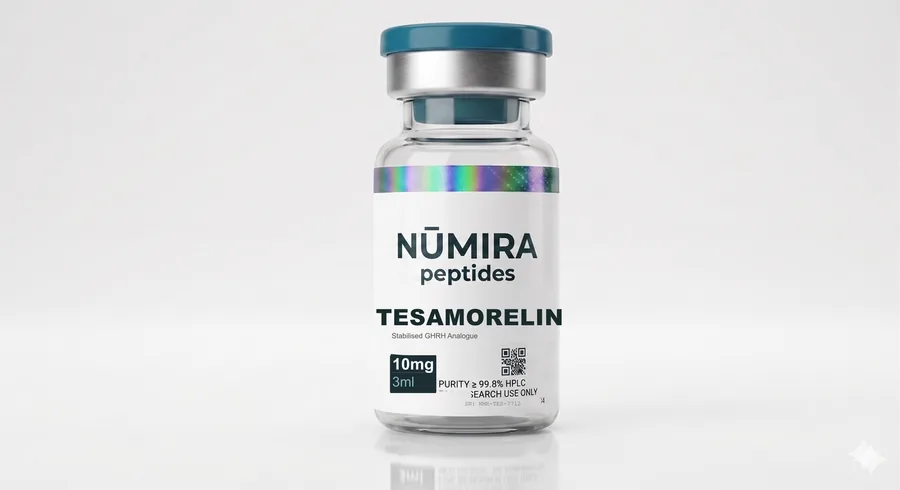
Tesamorelin (10mg) — Research Grade
Third-party tested · >98% purity · Lyophilized powder · Ships across Canada
Shop Tesamorelin →