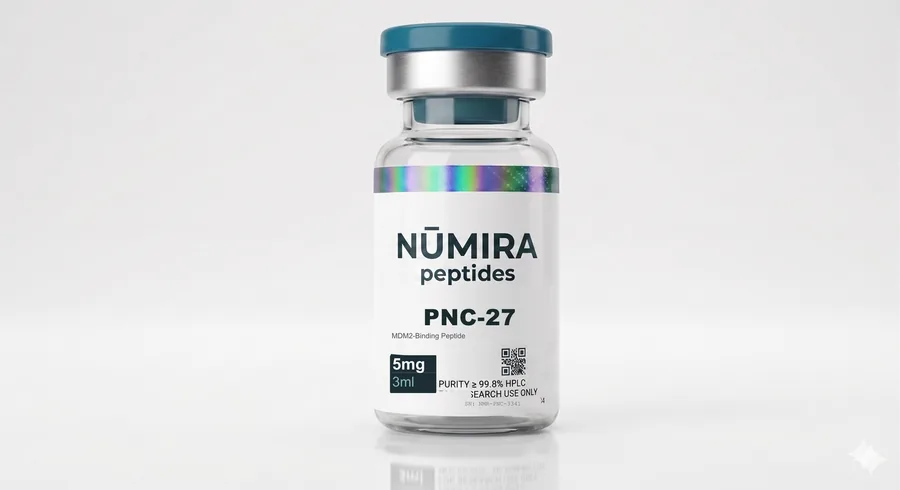

What is PNC-27?
PNC-27 is a synthetic peptide consisting of two parts: a "homing" sequence from the p53 tumor suppressor protein and a "penetrating" sequence that allows it to interact with cell membranes. Unlike traditional chemotherapy, which works by poisoning the whole body, PNC-27 is designed to act as a physical disruptor of cancer cell integrity.
In scientific research, it is classified as a "membranolytic" peptide because it kills cells by physically tearing holes in their protective outer layer.
⚗️ Key Research Facts
- Molecular Type: Chimeric Peptide
- Target Protein: HDM2 (Membrane-bound)
- Primary Goal: Selective Cytotoxicity
- Action: Rapid Necrosis (Lysis)
Mechanism: Membrane Pore Formation
PNC-27's mechanism is highly physical. Most anti-cancer drugs try to trigger "apoptosis" (suicide), which can be blocked by mutations in the cell. PNC-27 bypasses this:
- Recognition: The peptide's homing sequence identifies and binds to HDM2 proteins.
- Transmembrane Insertion: Once bound, the peptide inserts itself into the cell membrane.
- Pore Formation: Multiple peptide molecules group together to form a "pore" (a hole).
- Lysis: The cell's internal pressure causes it to burst (lyse), leading to rapid death before the cell can replicate.
The HDM2 Targeting Selectivity
A major question in oncology is: how do we spare healthy cells? PNC-27 research relies on the fact that **cancer cells express HDM2 on their outer surface**, whereas healthy cells keep their HDM2 hidden deep inside. Because the peptide cannot reach the internal HDM2 of healthy cells, it only "punches holes" in the cancer cells.
p53-Independent Cell Death
Many cancers become resistant to treatment because they have a mutated or missing **p53 gene** (the "guardian of the genome"). Because PNC-27 works on the outside of the cell and doesn't rely on the p53 gene to function, it has shown efficacy in research models against highly resistant, p53-null cancer lines.
Broad Spectrum Potential
Studied for use against leukemia, breast cancer, melanoma, and pancreatic cancer cell lines.
Minimal Resistance
Physical membrane disruption is much harder for a cancer cell to "evolve" around compared to chemical inhibitors.
Research Protocols & Dosing
- Administration: Intravenous (IV) or Subcutaneous.
- Research Dose: Animal models typically use 10 mg to 50 mg per kg of body weight.
- Frequency: Administered daily or every other day during the treatment window.
- Side Effects: Generally localized; no systemic toxicity has been reported in published animal safety studies.
- Storage: Lyophilized powder in the freezer. Reconstituted solution must be used within hours.
Frequently Asked Questions
Does it replace Chemo?
In a research context, PNC-27 is often studied as a "synergistic" agent. By weakening the cancer cell's membrane, it may allow traditional treatments to enter and kill the cell more efficiently.
Is it "p53"?
No. It *uses* a small part of the p53 protein as a homing device, but it is not the full protein. This makes it much smaller and more stable for research applications.
Where to buy PNC-27 in Canada?
Nūmira Peptides offers high-purity PNC-27 for advanced oncology and molecular biology research. Shop PNC-27 →