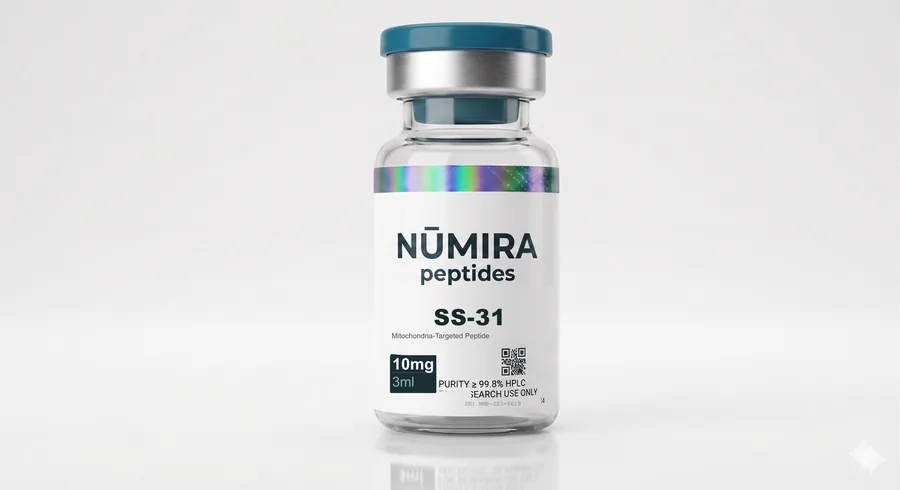

What is SS-31?
SS-31 is a synthetic tetrapeptide (D-Arg-dimethyl-Tyr-Lys-Phe-NH2) and the leading compound in a class of molecules known as **Szeto-Schiller (SS) peptides**. Unlike traditional antioxidants that simply neutralize free radicals, SS-31 travels directly into the "engine room" of the cell—the mitochondria—to fix the problem at the source.
Because it carries a positive charge and is highly lipophilic, SS-31 can easily cross cell membranes and accumulate 1,000 to 5,000 times more densely in the mitochondria than in the rest of the cell.
⚗️ Key Research Facts
- Molecular Formula: C32H49N9O5
- Pharmaceutical Name: Elamipretide (Bendavia)
- Primary Target: Cardiolipin (Inner Mitochondrial Membrane)
- Role: Mitochondrial Bioenergetics Restoration
Mechanism: Cardiolipin Stabilization
The Inner Mitochondrial Membrane (IMM) is where the Electron Transport Chain (ETC) produces energy (ATP). The structure of this membrane depends entirely on a unique phospholipid called Cardiolipin.
Fixing the "Scaffolding"
In states of aging or disease, cardiolipin becomes damaged by oxidative stress. This causes the ETC "supercomplexes" to fall apart, leading to energy failure and more free radical leakage. SS-31 binds selectively to cardiolipin, providing a molecular "scaffold" that stabilizes the membrane and allows the energy-producing machinery to function efficiently again.
Reducing Mitochondrial ROS
Mitochondrial Reactive Oxygen Species (ROS) are a primary driver of aging and cellular damage. By optimizing the efficiency of the ETC, SS-31 significantly reduces the "leakage" of electrons that normally form ROS.
- Inhibiting Peroxidase Activity: Prevents cytochrome c from becoming a destructive enzyme that further oxidizes the mitochondrial membrane.
- Preventing MPT Pore Opening: Blocks the "death signal" that causes cells to self-destruct during severe stress.
Research Applications & Myopathy
Research into SS-31 covers a broad range of mitochondrial dysfunctions:
Neurovascular Health
Studied for its potential to improve cognitive function and blood flow in aged neurological models.
Mitochondrial Myopathy
Primary focus for treating conditions where muscles cannot produce enough energy due to genetic mitochondrial defects.
Kidney Protection
Shows promise in protecting renal tissue from ischemic and diabetic damage in research models.
Research Protocols & Dosing
- Administration: Subcutaneous injection.
- Research Dose: 4 mg to 40 mg daily.
- Cycle Duration: Research studies often observe effects over 4-week protocols.
- Side Effects: Generally well-tolerated; primary research observations include temporary injection site redness.
- Storage: Lyophilized powder should be stored in the freezer. Reconstituted solution must be refrigerated.
Frequently Asked Questions
Is SS-31 an antioxidant?
It is more accurately described as a "mitochondria-targeted bioenergetic stabilizer." While it reduces oxidative stress, it does so by fixing the mitochondrial machinery rather than just scavenging free radicals like Vitamin C.
Can SS-31 help with fatigue?
In models of mitochondrial dysfunction, researchers observe significantly increased ATP (energy) production and reduced fatigue, though it is not an approved treatment for chronic fatigue syndrome.
Where to buy SS-31 in Canada?
Nūmira Peptides provides high-purity SS-31 (Elamipretide) for laboratory and scientific research purposes. Shop SS-31 →