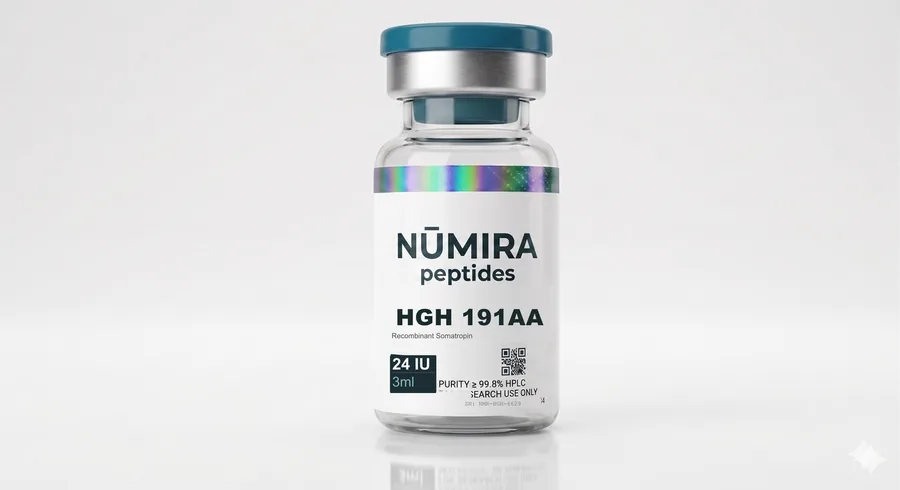
What is HGH 191AA?
Human Growth Hormone (HGH), or somatotropin, is a protein-based peptide hormone that stimulates growth, cell reproduction, and cell regeneration in humans. The "191AA" designation confirms that the peptide has the exact 191-amino acid sequence found in nature. This is critical in research, as older "192AA" versions (somatrem) often caused the body to produce antibodies against the hormone.
Recombinant HGH is produced using E. coli or yeast cells that have been genetically modified to carry the human gene for growth hormone, ensuring a bio-identical product for scientific study.
⚗️ Key Research Facts
- Molecular Weight: ~22,124 Daltons
- Sequence: 191 Amino Acids (Bio-identical)
- Secondary Messenger: IGF-1 (Insulin-like Growth Factor 1)
- Role: Master Metabolic & Regenerative Regulator
Mechanism: The HGH/IGF-1 Axis
HGH 191AA works through two distinct biological pathways: **Direct** and **Indirect**.
The Liver Connection
The indirect effects are largely mediated by the liver. When HGH reaches the liver, it triggers the production of **IGF-1**. This secondary messenger then travels through the blood to bind to receptors on bone, muscle, and cartilage, driving the actual growth and repair processes.
Direct Effects on Lipolysis
One of the primary "direct" actions of HGH is the mobilization of body fat. HGH binds directly to receptors on adipocytes (fat cells).
- Inhibiting Uptake: Prevents fat cells from taking up circulating lipids from the blood.
- Stimulating Breakdown: Triggers the breakdown of stored triglycerides into free fatty acids to be used for energy.
Indirect Effects on Protein Synthesis
While HGH doesn't directly build muscle as effectively as testosterone, its indirect IGF-1 pathway is essential for **Hyperplasia**—the creation of new muscle cells—rather than just the enlargement of existing ones (hypertrophy).
Bone Mineral Density
Increases bone calcium retention and strengthens the skeletal framework in research models.
Recovery & Repair
Accelerates the healing of connective tissues, tendons, and ligaments by stimulating fibroblast activity.
Research Protocols & Dosing
- Administration: Subcutaneous (for fat loss) or Intramuscular (for systemic repair) injection.
- Research Dose: Measured in International Units (IU). Typical research doses range from 2 IU to 4 IU per day.
- Timing: Best administered in the evening or upon waking, when blood sugar is low, to maximize the lipolytic effect.
- Side Effects: Carpal tunnel symptoms, water retention (edema), and elevated blood glucose levels.
- Storage: Lyophilized powder must be kept refrigerated. Once reconstituted, it is extremely fragile and stable for only 72 hours (non-preserved) or 14-21 days (with bacteriostatic water).
Frequently Asked Questions
Is 191AA better than 192AA?
Yes. The 192AA version (somatrem) contains an extra methionine amino acid. This makes it a "foreign" protein to the human body, often leading to an immune response that neutralizes the hormone. 191AA is bio-identical and does not have this risk.
Does it help with sleep?
HGH is naturally released in large pulses during deep (Slow Wave) sleep. In research models, supplemental HGH is often noted to improve sleep quality and REM cycles as the body enters a deeper state of recovery.
Where to buy HGH 191AA in Canada?
Nūmira Peptides offers laboratory-grade HGH 191AA for research purposes. Shop HGH 191AA →