What is CJC-1295 DAC?
CJC-1295 is a 30-amino acid peptide analogue of GHRH. While the original GHRH has a half-life of only a few minutes, CJC-1295 was modified to be more stable. The "DAC" version goes a step further by adding a chemical moiety that allows the peptide to bind to **albumin**, the most abundant protein in the human blood.
This binding protects the peptide from being broken down by enzymes, extending its half-life from minutes to over a week. In research, this makes it the premier choice for investigating the long-term effects of sustained growth hormone axis stimulation.
⚗️ Key Research Facts
- Type: Long-acting GHRH Analogue
- Half-Life: ~6 to 8 Days
- Binding Partner: Serum Albumin
- Primary Effect: Sustained IGF-1 Elevation
Mechanism: The Drug Affinity Complex (DAC)
The DAC (Drug Affinity Complex) is the "magic" behind this peptide. Once injected, the DAC moiety forms a covalent bond with albumin. Because albumin has a very long life in the body, it acts as a "reservoir" for the CJC-1295, slowly releasing the active peptide into the pituitary gland over several days.
Stimulating the Somatotrophs
The peptide binds to GHRH receptors on the somatotroph cells in the pituitary, signaling them to increase the production and release of endogenous growth hormone. Unlike synthetic HGH, it encourages the body's own glands to work more efficiently.
Pulsatile vs. Sustained GH Release
In research, the choice between CJC-1295 "No DAC" and "DAC" is based on the desired pattern of GH release:
- No DAC (Mod GRF 1-29): Produces a "pulse" of GH that lasts for about 30–60 minutes. Requires daily injections. Best for mimicking natural rhythms.
- CJC-1295 DAC: Produces a constant, elevated baseline of GH. Requires only 1–2 injections per week. Best for achieving maximum IGF-1 levels in research models.
IGF-1 Elevation & Research Findings
Research has shown that a single 60 mcg/kg dose of CJC-1295 DAC can increase mean plasma GH levels by 2–10 times for up to 6 days. More importantly, it increases **IGF-1** levels by 1.5–3 times for as long as 9–11 days.
Improved Body Habitus
Sustained IGF-1 elevation is linked to improved muscle protein synthesis and fat oxidation in metabolic research.
Cellular Repair
The constant presence of GH and IGF-1 supports systemic tissue repair and recovery in research models.
Research Protocols & Dosing
- Administration: Subcutaneous injection.
- Research Dose: 1 mg to 2 mg per administration.
- Frequency: Once or twice per week.
- Side Effects: Generally well-tolerated; primary research observations include a temporary "head rush" or flushing immediately after injection.
- Storage: Keep lyophilized powder in the freezer. Reconstituted solution in the refrigerator.
Frequently Asked Questions
Is it better than HGH?
In research, CJC-1295 DAC is often preferred over synthetic HGH because it preserves the pituitary's role in regulation and avoids the "shutdown" of natural GH production that can occur with exogenous growth hormone.
Does it cause water retention?
Because it causes a sustained increase in GH, some research models observe temporary water retention (edema) or joint discomfort at higher doses, which typically subsides when the dose is lowered.
Where to buy CJC-1295 DAC in Canada?
Nūmira Peptides offers laboratory-grade CJC-1295 with DAC for scientific research with domestic shipping across Canada. Shop CJC-1295 DAC →
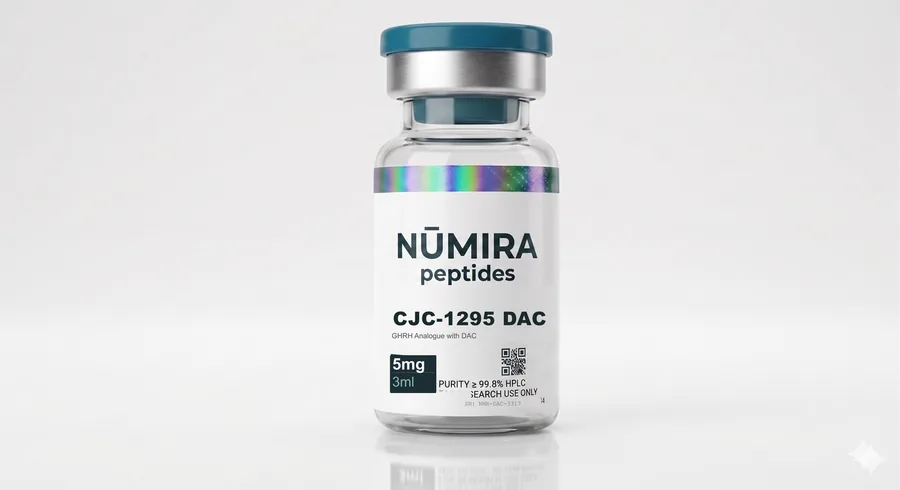
CJC-1295 DAC — Research Grade
Purity >98% · Long-Acting GHRH · Domestic Canadian shipping
Shop CJC-1295 DAC →